
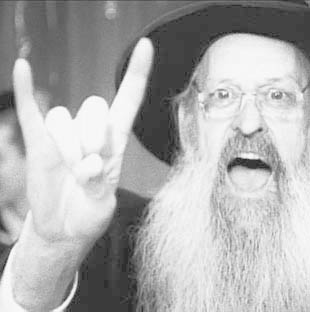
 I recently ate a someone’s house who’s involved in Kiruv, he couldn’t find a house in the eruv so he had to settle for one outside the eruv and in order for his wife to get to shul with their small children when there are events she needs to attend – she hires a non-Jewish pusher, something I have heard to be shunned by the right wing factions of the Jewish community. When I asked my host of this, he stated that they received a heter kiruv, which led me to thinking of all these different heterim one could get if they are in kiruv.
Other possible heters for kiruv:
Allowing kol isha: You have to get those poor public school girls to learn the benching right?
Mixed dancing: What’s a good kiruv event without a lively havdallah – yes some girls and guys may put their arms around each other during a particular carlbachian high, but it’s for the best.
Mixed seating: I have noticed that many kiruv folks have evengts thatg are mixed seating and I figure that must be one more heter kiruv.
Internet: Though many espouse the banning of the internet once they achieve a certain level of frumkeit, they must get them there in the first place and there’s no better way to do this than through the internet – it’s a necessary evil.
Women as leaders: I have noticed that kiruv organizations like NCSY allows women to be elected to all sorts of leadership roles and although the official stance of Young Israel is to not have women as presidents, I always figured this was just a scam to make girls realize that being a leader is fine when you’re on your way up to a life of baby making and butter churning.
College: It seems that many kiruv organizations acknowledge that college may be kosher by sending young couples to be missionaries on college campuses, this means they are supporting those students with shabbos meals and basically saying that we will treat you like ordinary yidden if you attend college – just another heter I guess.
Our Chabad rabbi definitely uses a non-Jewish stroller pusher on shabbos sometimes, if I recall correctly. I’ve also seen mixed dancing and kol isha at kiruv events for sure.
oh dear….
no mixed dancing at havdalah.
mixed seating isnt a heter kiruv, its just being normal
ditto goes for internet, women leaders and college.
i hate the term “kiruv klown” but if anyone in kiruv uses a “heter kiruv” they most certainly are Klowns.
The concept of a Heter Kiruv definitely does exist, this post just blows it out of proportion. The fact is, many times (that I have seen myself) people are given heterim for the purpose of kiruv that they would never have gotten otherwise. It’s not being a “Kiruv klown”, it’s halacha.
I know someone who was told to sit only one day of shiva for his father, since his absence was causing tens of people to be overlooked. I know someone else who was given a heter to take non-frum teenagers to a concert, regardless of the inevitable fraternization which would occur. I think this was actually the idea…. to somehow prevent intermarriage.
While the extent of a legitimate kiruv heter is debatable, there most certainly is such a thing.
To bring you a real source, one of the tannaim (R’ Shaul), was sent by the Rabbanim of the day to fix the problem of Christianity. It seems that the original Christianity was very similar to Judaism – except for some core beliefs, like the human G-d, and therefore many of the unlearned were susceptible to it. So R’ Shaul (now St.Paul) was sent to fake conversion to Christianity, climb the ladder, and make some vital changes to the religion. This would require that he stop observing Torah (outwardly at least) meaning chillul shabbos, tarfus, whatever necessary, (aside from the 3 biggies of course).
That’s the Toldot Yeshu story which claims that Simeon Kepha (who was supposedly Paul) worked undercover to radically change the belief system of the Christian Jews. It has nothing to do with kiruv. More importantly, it has no standing as an halachic source.
Heshy, having a non-Jew push a stroller when there is no eruv is accepted in all circles. It is because of the principles of shvus d’shvus. You can find this in Rabbi Ribiat ‘s 39 Melachos book.
Nonetheless, your irony is dead on.
Not in my shul – the Rabbi in San Jose says “no way jose”
But he is a bit machmir – he doesn’t let the women come and learn on shavuos euther
I believe it would be issur to HIRE someone to do that specific task. But, if you could get someone to do it as a favor, or have someone who is already in your employ to do it as part of their regular duties (nanny, housekeeper, etc) then it’s allowed as a shvus d’shvus.
I went to a place where the Rabbi let non-jews drive the kids to the shul on Shabbos. Has anyone ever heard of this?
As the modern “kiruv” movement was created by Chabad, it would make sense to look at how these issued are handled by Chabad. Chabad has a very high standard and goes by the well known dictum. Of not bringing Torah down to the people, but bringing people up the the Torah. Incidentally, sending shluchim (“missionaries”) to college campuses is not tacit approval of college. By the same token you should say that being friendly to a non frum person shows an acceptance of their life style.
Please tell me you’re joking.
why?
Chabad didn’t ‘create’ kiruv. They were one of the first ones to take the initiative back in the 50’s, but the movement which followed was not a continuation per se of what Chabad was doing. Quite the contrary. Chabad would deliberately sabotoge any attempt of mainstream kiruv, since anyone who found out about Judaism from non-Chabad kiruv was very unlikely to ever become Chabad, and would therefore never be a “religious Jew”.
And while there are certain things which Chabad sheluchim are careful with, they are very far from having a “high standard”. Placing teenage boys in busy bus stations to approach scantly clad chicks and strike up conversations with them does not come from having a “high standard”.
I will say without reservation that Chabad sheluchim are on average the most efficient kiruv professionals today, but call a spade a spade, that ‘dictum’ has much to be desired in Chabad.
As the son of a Chabad shliach I can tell you that we don’t have a problem with non-chabad kiruv. It becomes a problem when misinformed chabad-haters such as yourself become kiruv rabbis and asperse the existing chabad rabbi.
Oh, how sad! The poor innocent peace loving Lubavitcher victim can’t understand why all these wicked people are picking on him. All he ever did was try to serve H-shem, right?
You say your father never minded non-chabad kiruv? One of three things:
1) You live in a place where there IS no non-Chabad kiruv.
2) Your father is one of the few Chabad exceptions.
3) You’re lying through your teeth.
One of the fundamentals of Chabad kiruv is PR. So at least admit that in the event that your father would in fact resent mainstream kiruv, you would attempt to deny it. No?
Good points. Seems like there’s a lot of deception involved in these Kiruv activities. Whats the Heter for that?
the whole eruv thing is a cheat, anyway. i mean i know we all love it but it’s really a cheat. ditto with getting a goy to push baby carriages. it’s like getting caught stealing a TV and saying it was on sale anyway.
That is ridiculous.
Eruv only works in areas where the prohibition against carrying is rabbinic. The rabbis who prohibited it, also allowed it with an eruv.
(If it helps, just imagine that instead of a prohibition, they just mandated an eruv in these areas, with the penalty for non-compliance that you can’t carry.)
There is no loophole.
Seriously, how many times does the “Eruv is not a loophole” explanation have to be given?
“If a person kills another person he is guilty of murder….unless doing so as uniformed soldier or a police officer”
“Police is a LOOOPHOLE!!!!”
That’s the same logic.
You forgotthe biggest heter – to misrepresent, distort and disinform. Vehamvin Yavin.
The melachot of Shabbos are based on activites necessary for building the mishkan or something to that effect. Did anyone push a baby carriage to build the mishkan? 😉 The “carrying” from one area to another one is the lamest melachot. Maybe they should also have banned walking on Shabbos, as I am sure some walking was required to build the mishkan.
Eruv is a loophole. Manhattan, with a string around it, is NOT a singular private domain. We just make believe it is.
avrumy it dosent really make a difference if you “carry” pull, or push from one rishus to another (you can even throw something and be chayiv). the point is that you moved it from one rishus to another on shabbos.
fyi by walking you dont have to bring anything other than you, your clothing, and maybe some tachshitin from one rishus to another, in which case there is no problem
interesting enough though in some cases clothing itself can be a problem. according to reb moishe if you roll up your cuffs on shabbos and go for a walk its considered carrying.
also the reason why lubavitche chassidim dont tuck in their shirts on shabbos (i m not sure why they also don’t during the weekdays) is because they keep their tzitzis out- and if they’d tuck themselves in and just keep their tzitzis out then the corner of their arba canfos would fold up and they’d be carrying
My point is that moving something because things were “moved” in the building of the mishkan is a bizarre idea of melacha. The idea that moving a tissue (or a dining room table) from one rishus to another on Shabbos is a melacha is abuse of early rabbincal power. I know my point has no influence, but a rational point of view should always be welcomed, if only to be pooh-poohed.
“Carrying” your rolled up shirtsleeves is beyond irrational and proves my point. But, let the true believers believe. No sweat. Or is sweating on Shabbos also a melacha of some sort?
so what is the reasoning behind the para aduma?
i guess that me being an ultra-orthodox jew, i find it hard to see your point of view. the end of the 1st mishna in pirkei avos (actually this past weeks perek for those who say pirkei avos during the weeks between pesach and shavuos) states that (one of the 3 things) you (the rabbonim) should make a gate around the torah. now to explain it (with the age old mushul): if your father didn’t want you to go somewhere he’d tell you not to go there, but your mother would tell you not to go within (lets say) 5 blocks of it. the same is true here: the torah says dont do melacha, and the rabbonim classify what is called a melacha by what was done in the building of the mishkan.
what you should probably do is check up on the sugya before saying such things about people whose greatness and vastness in knowledge you cant even come close to comprehend. i doubt that you even know one perek of shas by heart (and they knew tnach, shas, sifra, sifri, mechilta……etc). not saying that i know anything by heart either, just that i know enough that i wouldnt say such of those who are greater than myself.
if your sweating because you exerted yourself then yes the exertion is assur, unless your doing it for a dvar mitzva; like running to shul…(though i don’t think that the sweat itself is assur- though supposedly the only bodily sweat that isn’t toxic is facial sweat, so i wouldn’t go ahead and drink it if that’s what you mean ;^)
to my knowledge there is a whole perek in mesechta shabbos dedicated to this subject of carrying, so if you’d like you can read/learn up on it. hatzlacha rabbah, take luck and good care
Um. Parah Adumah can be explained in 1 page.
http://midrashicmusings.blogspot.com/2010/06/explaining-red-heifer.html
As a note, I wouldn’t necessarily mention the bris in that list of things you mentioned as not being forbidden as part of the 39 melachos being that is actually is melacha, but we’re allowed to do it for other reasons as discussed in the gemara (similar to all the many exceptions that let you do melacha for pikuach nefesh, etc).
Otherwise, great post.
Yes, your imagination of what a “singular private domain” is irrelevant.
Your error is in assuming that “melacha” must have some rational relationship to your definition of “work”.
I also question, if you say that the definition of melacha is an abuse of early rabbinical power, then you presumably agree that the torah is from G-D. (since if the whole thing is rabbinic, they cannot be abusing their own power.) If that is so, then why is it a big step for you to also believe that the oral tradition is from G-d, including the definition of “melacha”.
The conventional translation of Shabbos as the Day of Rest has not helped with general confusion on this issue. The vast majority of non-observant Jews understand that Shabbos is a day when work is forbidden, and so they aim to retain the spirit of the day by not doing something that they decide is work.
More educated Jews know that in halacha, “work” is actually defined by 39 melachos, the forbidden labors of Shabbos, including a wide range of constructive and destructive acts. These acts are the ones that were required for building the Mishkan, the Tabernacle.
Yet this does not go any distance in explaining why there is this connection between the Mishkan and Shabbos. And so we are left with a big gap between Jews: Observant Jews explain that there are 39 melachos, etc. – but we essentially follow these laws because that is what we are told to do. Nobody becomes Shabbos observant because they are impressed by the beauty of its connection to the Mishkan. Those of us who are Shabbos observant often fall back on the English translation – we define “work” as the 39 melachos, even though if we think about it, there are plenty of things we can do on Shabbos that are not forbidden within the 39 melachos.
For example: on Shabbos, one is permitted to pick up a heavy stack of bricks in one’s home, move it 10 feet, then move it back again, ad infinitum. One is permitted to learn Torah, as well as to come up with new ideas. We spend a lot of effort on family, and guests, and festive meals. We use the spoken word to sanctify and bring in Shabbos itself. We can visit the sick, give an 8 day old boy a bris, or a host of other things that require concentration, or work up a sweat. We are even encouraged to engage in the ultimate physical creative act: procreation. None of these acts is forbidden on Shabbos.
We are only – and specifically – forbidden to do acts that were done in the making of the Mishkan. It has nothing to do with work – the answer is in the Mishkan!
The Mishkan (and by extension, the Beis Hamikdash) is G-d’s “permanent” home among the Jewish people. The making of the Mishkan is part of the fulfillment of our role on this world: to make the world a place where G-d is welcome, to create a structure where Hashem feels at home.
Building the Mishkan is a necessary and critical step for the reunification of heaven and earth, to undo the separation of the waters above and the waters below. It is, in a nutshell, essential to our Jewish destiny. Preparing the groundwork to make the Mishkan possible was the core accomplishment of pre-Egypt Judaism, and building the Mishkan (and then the Beis Hamikdash) was the core accomplishment of the Jews in the wilderness and then Ancient Israel. Building a home for Hashem is what Judaism is all about.
All well and good: but what does the Mishkan have to do with Shabbos? To answer, this, we have to think of them as different dimensions. The Mishkan is holiness in place, and Shabbos is holiness in time. Shabbos is the time in which we are barred from performing work – defined by the acts used to build the physical Mishkan. All week long we should strive to do the things that make a home for G-d on this earth. But on Shabbos, anything that smacks of making a physical home for G-d is forbidden to us.
Shabbos is called a taste of the World to Come, of when Moshiach is with us. It is a time when we experience the unification of heaven and earth, and the holiness within it. As a time carved out of time, Shabbos is our link to what the world should become after we have finished the weekday efforts of building a physical home for Hashem.
On Shabbos we cannot do melachos that were used for the Mishkan because on Shabbos, building the Mishkan is unnecessary. If we did melachos on Shabbos, we will have missed the point of Shabbos entirely!
If we do a melacha on Shabbos, we are rejecting the power of Shabbos itself to bring Hashem into our homes and lives. Mishkan and Shabbos as two different aspects of the same goal for the Jewish people, remain mutually exclusive. We cannot build the Mishkan on Shabbos, and inside the Mishkan, Shabbos prohibitions do not apply. Neither is allowed to conflict with the other.
On the other hand, while melachos are forbidden, the act of creation is not. We bring Shabbos in with mere words, and we take its leave the same way. Within Shabbos, we are free to talk, to pray, to think, to learn and to love – all are acts of creation, sometimes of the highest order.
all in a nutshell. impressive
Thank you! I am honored.
i love the halachic debates that spring up on here.
Seriously, u need a heter 4 college?!?!?!?!
to go to college?
depends, if you’re ultra+ultra orthodox then i dont know if a heter will help
if you’re ultra orthodox then you need a heter
if you’re orthodox then you needn’t apply for a heter
if you’re MO then you have to go to college
all in good humor ;^)
That’s actually what Rabbis Shlomo Carlebach and Zalman Schachter-Shlomi did in their House of Peace and Love in San Francisco. They had mixed seating, I believe, for some things, and they got reprimanded. RSC retreated and RZSS founded renewal.
I don’t know how you can compare the two. RSC was a well meaning but misguided Jew. RZSS was just a pervert who liked the attention.
“Nobody becomes Shabbos observant because they are impressed by the beauty of its connection to the Mishkan”
Im not sure about that – a truely frum O or right wing masorti should do it cause halacha is halacha, and Reform and left wing Masorti who do it for general spiritual beauty usually arent interested in the mishkan – but I suspect some Masorti, renewal, recon, etc are aware of the mishkan connection and its ONE aspect of the thought about it that leads them to observance.
Hi! This is my first visit to your blog! We are a team
of volunteers and starting a new initiative in a community in the
same niche. Your blog provided us beneficial information to work on.
You have done a marvellous job!