
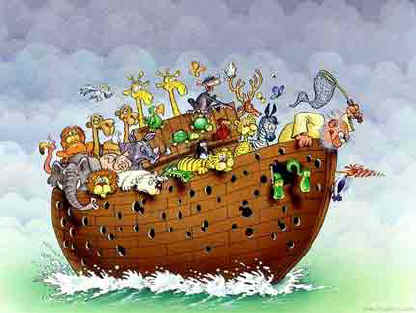
 My daughter, Tzipporah, is turning 5 on Sunday and she just started Pre-1A at the local yeshiva. Over the past few weeks, I’ve been faced with my first dilemmas as a parent in terms of being a rational adult and at the same time, being a parent of a child who is told tales of whales and other legendarily fine examples of Jewish folklore.So, as most would do, I contacted my spiritual adviser. The discussion went as follows:
Me: “Rebbe, what should I do? My daughter came home with a story that some guy was swallowed by a big fish, and that she forgot his name. So my wife responded that it was “Yonah.” What should I do?
SA: You could ask her how many fish swallowed the man in the story.
Me: But it didn’t happen! It’s only a story!
SA: Who said it happened? Didn’t your daughter come home and say, “I heard a story about…”
So there you have it — I asked her how many fish swallowed the man, and she remarked with sudden recollection that, in fact, two fish were involved — the first fish was too cozy and comfortable and so the man refrained from repenting, but when he got into the second fish, which was cramped and uncomfortable, he returned from his transgression.
And when we ate out on the second day of Succos, my daughter suggested that we state the Ushpizin for the day, and the host added to his son, “yes, slide over and make room for Yitzchak. When I interjected that Yitzchak wasn’t actually coming because he had died thousands of years ago — let’s just say that for the remainder of the meal, all conversation between the two adults males present revolved around angels, giants, carbon dating, dinosaurs and talking snakes who wish to mate with humans. Needless to say, the only time we’ll be invited back will be so that he can be mekareiv me.
In continuing with my spiritual adviser, he suggested the following analogy: “When we’re young, we’re told that we have blood in our body, and we all think that our entire insides are just full of blood sloshing around all over the place. We get a little older and we learn blood is actually confined to hundreds of thousands of tiny tubules that carry the blood to nearly all the cells in the body. We get a little older, and assuming our hero is not majoring in finance and taking bio for poets (or truck drivers), he learns that the real deal is that capillary walls are sometimes continuous, sometimes discontinuous and even sometimes fenestrated. So why not just start everyone off right? Because they can’t handle it — so we refine the story with time.”
A while back, I decided that, had I been Christian, I would tell my children from a very young age that there is indeed no such thing as an actual Santa Claus. I therefor eschew Jewish Santa Clauses — and they abound, believe you me (what does that last statement even mean? I don’t know, but it fit!)
But everyone else likes Santa Claus — he’s VERY popular! In speaking with my spiritual adviser, based on his blood circulation example above, I find that he thinks these stories are great — they get the kids involved, they explain things on a simple level and desirable messages are taught. The problem is not the stories — it’s letting kids turn into the age of maturity and allowing them to still think that Santa Claus exists. I disagree, but I suspect that it’s a personal philosophical disagreement rather than a generalized, overarching form of discontent.
Why do you send her to a school where they teach her this stuff in the first place?
Maybe because they want their grandchildren to be Jewish.
It’s apparent that they teach this stuff everywhere — and by “everywhere” I mean to say anywhere at which the level of religious commitment matches that of Torah-true Judaism. The teachers may be deficient in their grasp of reality, but only in limited realms and I suspect that those who are not cost too much to employ; or, the teachers may just be telling stories to kids, and the stories do exist, so no harm done. It’s skipping the debriefing that’s the real problem.
Moreover, the majority of parents lack a true grasp of reality, and so there would be too many people related to the school board, the parent body and everyone else to effectively inform and it would take to long to accomplish — my daughter will graduate in 9 years and I don’t think even that’s long enough.
Are there any biblical stories of miracles that you accept?
Creation?
The flood?
10 plagues?
splitting of the sea?
Matan torah?
etc etc
Why is it that Yona is always the example that comes up as a story that couldnt happen, why is that harder to believe than any othe biblical account of a miracle?
Incidentally im trying to find the connection between this post and the ARk, i guesss its implicate. Im having an even harder time finding the connection between this a a devar torah, hope you can help
Thanks
The obvious questions almost ask themselves “What do you know, and how do you know it?” If your standard is “Anything in this Book must be literally true,” then you must perforce believe everything in the Book in the absence of all other evidence. It also forces you to discard any contrary evidence, generally with contortions worthy of a yoga master or a barely prehensile “Just ’cause!”
Then we have to ask “How do you know that everything in the Book is true?” It generally comes down to personal connection to the people who taught you combined with the hope of reward and the fear of punishment. That’s pretty thin epistemology.
So do I believe in any of the miracles? I’m open minded and don’t say “They couldn’t have happened.” But in order to be honest one has to treat accounts with the same critical eye one does other such. That means being more skeptical when it looks like older stories had the serial numbers filed off and more believing when there’s other corroborating evidence. It isn’t easy. The rewards are worth it.
Well, to be fair I wouldn’t equate a living tradition with a yoga “Just ’cause”.
It’s not like a whole bunch of people are all just finding the Bible now, and all giving their opinions to what probably happened – without any external knowledge.
There are somewhat reasonable leanings and ways of looking at it on all sides.
Apparent contradictions in science is one way, similar stories reported in other history books is another, archeology, etc.
And for the fundamentalist, the tradition we recieved regarding how to understand the stories is the true way to view them and how they actually happened.
I also wouldn’t limit the ability for one to maintain the fundamentalist view to a “personal connection to the people who taught you combined with the hope of reward and the fear of punishment” – which I’ll admit is a pretty thin epistemology.
It’s an entire picture of how the Torah was given and passed down, which sits very comfortably with certain people. Some who have the “personal connection” thing and some who don’t.
I would just like to mention, that the stories as they are told in the actual text are very often incomplete in a historical sense (for various reasons, mainly because the Torah tells us of events for growth and not informative purposes.)
For example, the Rambam states in Moreh Nevuchim, that Balaam spoke to the donkey in a prophetic sense. And although virtually everyone disagrees with him on that point, we see clearly that it is reasonable to understand stories in Tanach in a very different context than stated.
Or an even better example from Hoshea the prophet, who was instructed by G-d to take for himself a prostitute to be his wife and have children with her. There is a dispute regarding the plane on which this episode took place, some maintaining that it happened in a vision and not in reality.
Likewise, the vast majority of conversations which took place in the stories, were far more detailed and complicated than they appear in the text, with the text just skimming over a few important pieces of the conversation.
But what is unanimously agreed upon by all fundamentalists, is that the only interpretations acceptable – are those passed down to us by those who we believe ultimately heard it from the source, the same way we will only pass down to our children what we recieved, and that is has not been doctored, changed, added to, or watered down in any way.
Likewise, if it has been passed down to us that a given story actually happened, that has the same validity as any other aspect or idea of our Torah.
Therefore, I don’t really see why it would make more sense to “be more skeptical” based on information which has no more validity than the reasons why we believe the stories in the first place.
I dont know if you’ve read Shomer Emunim (hakadmon), but he takes serious issue (in one of the earlier questions) with that specific claim of the Rambam in the Moreh because he seems to be picking and choosing what he likes in the Chumash based on his philosophic weltanschauung. This, he argues, relegates the Chumash’s veracity to a status where it is contingent on current philosophic thought. [He blames this on the Rambam’s ignorance of Kabbala.]
The Ramban, on the other hand, did learn Kabbala (he says so himself in his intro to chumash) and he has no problem saying things are miraculous, or that angels can come into existence in the physical world, or that there is magic.
He only learnt kabbalah later on in life, after the Mishna Torah and Moreh Nevuchim.
The common belief is that he did indeed reject many of his earlier teachings.
The Sh”E quotes a few big names, albeit yechidim, who bring sources of proof to suggest he did learn kabbala later and rejected his earlier explanations. But he prefaces it by saying something close to, “if you choose to believe (in it)”.
My reply to you and someone else is currently awaiting moderation. I’m not discounting the issues you’ve raised or blowing it off. It just takes time to work through the system.
A. nuran,
i get that, completly.
However i dont get those who can accept the existance of a god who created heaven and earth ex nihilo but not that he could cause a person to live in a fish.
Or those who are willing to accept the story of the flood, but when it comes to fitting all the animals in the ark, thats where they have trouble.
Or those who can accept that god commanded us not to kill, but not that god commanded kohanim to refrain from marrying ddivorcees.
In all these examples if you are willing to strectch your beliefs for the first point, the second isnt a real question. And if you dont accept the exostence of god then the whole conversation doesnt start ie forget the jonah story, or the specific technial details of the flood, arent even worth bringing up
John — it seems that you might be missing the point. We all could have popped into existence 5 minutes ago and all of our memories could have been implanted into our brains — but that’s very unparsimonious. So to suggest that God created the world by the proverbial snap of his fingers is certainly a possibility — but that doesn’t come up as the best explanation of how chickens and turkeys possess perfectly identical 100 amino acid sequences in their cytochrome c molecules. Now, you probably look at these two birds and would say that they’re related — but if there was no evolution and all organisms as they exist today were created ex nihilo, there is no relationship between anything — turkeys and chickens are just as separate and distinct as turkeys and cows, and all were snapped into existence. So God could do almost anything, but the question is did he. If we have no compelling reason to say the evidence for a multi-billion year old universe is misleading other than Genesis, and we have compelling reasons from Chachmei Sfarad (R’ Saadia Gaon, Rambam) to take Genesis as non-literal, we can come to a conclusion that will not force one to deny his or her objective grasp of reality.
And this is the most important type of devar Torah — without a sense of what we know, how we know it and perhaps even why it matters that we know it, hearing explanations of why Cham was saved if he turned out to be such a bum or which species did Adam + Eve eat from might fall on deaf ears. As R’ Becher states ofter, meditation might be helpful and beneficial, but that doesn’t make Hinduism true. So just because we have nice stories doesn’t mean the lessons learned from them derive from God or the sages who have mastered his works.
Those are very good points.
If one grants that the world was created by an entity or entities, which is already a pretty big lump to swallow, much of the rest might well be possible. It doesn’t follow that the creation of the universe ex nihilo requires we believe a particular story about it or that other parts of the same group of stories is true. It could be someone else’s stories are true. Or none of them. Or we only got part of it and filled in the rest.
There are plenty of phenomena whose existence we can verify and understand now which we could not thousands of years ago. Among them are dozens upon dozens where it turns out all the Holy Books were dead wrong.
Then there’s the question of authority. If we accept that the laws written down in FOB came directly from the Divine that’s one thing. We then have a supposed Oral tradition which we are told was unaltered and passed down unaltered for centuries. Given what we know of other oral traditions that seems a stretch. Then, we must believe when it was written down over the course of decades it was untouched by politics, accretion from other sources, wishful thinking, misremembrance or who shouted the loudest. That text must also be considered uncorrupted and entirely correct.
After that we must believe that the intention of the Creator of at least this universe was that the scribes and lawyers are correct when they interpret on the basis of a couple carefully chosen passages that we must now and forever obey whatever the scribes and lawyers say and treat it as if God Itself said so. Their commentaries must be treated as essentially perfect unless we can create a set of very contrived circumstances which can never be achieved in the lab much less the real world. And by definition the only people allowed to participate are ones who would agree that their commentaries are essentially perfect. Remember what Bismarck said about the law and sausages. “It is better not to watch either being made.”
Parsimony would dictate that we take the FOB laws as more authoritative. The early Hebrew copies of the text – leaving aside the very real possibility that the original texts were in a different related language – largely agree. Textual analysis indicates relatively few hands at the pen (or chisel) unlike the Great Assembly. I’d be more inclined to believe that Kohanim shouldn’t marry non-virgins than the whole meat-and-milk bit or the bizarre “Down to the knee is alright. Past the knee is deformed” sophistry. The chain of custody is less muddled. For the record I’d have to say if you’re that mightily endowed, don’t worry about being a priest. You’re going to be Chief. All the men will fear you, and all the women will desire you 😀
Now that we’ve lifted the lid on the certifying texts, let’s get back to those miracles. It does not necessarily follow that an entity or entities which caused the universe to exists would be capable or even interested in providing oxygen and protection from digestion for a man inside a fish.
A universal flood is particularly problematic because we now have a pretty good idea of what its effects would be. We don’t see them in the physical world. We see evidence for many different localized floods at many different times, but nothing that indicates all the world was buried in water to the depth of the highest mountain. The questions about the preservation of all current terrestrial life, the molecular genetics, rates of increase and so on are serious ones. In order to defend it you have to keep creating new mechanisms with no predictive power, no parsimony, no falsifiability and no rhyme or reason which constantly change.
It isn’t just a matter of shooting the arrows and drawing circles around them. You have to take a rolling artillery barrage, draw circles around every piece of shrapnel and pretend someone else painted them thousands of years ago.
The standard responses to this are
1) We don’t know everything
2) God lied to us
2a) God let Satan lie to us
All are easily and brutally answered in ways with which I will not bore you at this time.
As Phil Messina says in his critique of the K.I.S.S. principle “It ain’t simple, and you ain’t stupid.”
John, I replied to this and in part to Yankel’s post. It is awaiting moderation.
That’s a very good question, and I would have to say that the Torah seems to be in parable form up to Abraham. From then on, it’s readily apparent that everything is meant to be a historical document, whereas before Abraham, the story-telling is less of a direct historical review. So on your list, I would put the break between the flood and the Ten Plagues.
But even then, it’s certainly debatable what occurred during the Ten Plagues. Let’s just take the first one, for example: Dam (Blood). The water turned to blood — what does that mean, exactly? Did the water turn to serum without clotting factors, or to plasma with clotting factors. It was red, I suppose — so that means there was hemoglobin? Was it in the form of invertebrate hemolymph, in which the hemoglobin is suspended in the plasma directly, or was the hemoglobin packed into cells, like in vertebrates? If there were red blood cells, were they enucleated, like human RBCs, or did they retain their nuclei, like reptilian RBCs. If they did have DNA, and we would have sequenced it, what sort of genome would it mimic? And blood has white blood cells as well, and what about complement and well, if you evaluate it from such a perspective, which they obviously could not have done anytime prior to modern times (and so this would invariably have excluded most major rabbinical authorities of the ages), you’re left with way more questions than answers. Not all meforshim agree that the 10 Plagues were as miraculous as they are taught in yeshiva — the problem is that those unfamiliar with science have little problem undermining it and they are primarily concerned about undermining the authority of Chazal. For those who are familiar with science, having Chazal undermine science is a greater discredit to them than saying they didn’t know any better because the best scientists of the day were no better than they were.
But dont you see regardless of what occured at the first plague, it was a miracle.
Are your questions of historical nature? regardless of whether the blood was serum, plasma, rbc’s etc etc. It was a miracle I cant comprehend why one is harder to believe than another
You make a very good distinction — yes, it was a miracle, but the question remains, “What was the miracle?” I don’t know because I wasn’t there, and there is far too much debate about it for us to be really certain, but that doesn’t stop many, many people from pretending that they are really certain, and they don’t think that they are pretending. It’s not harder to believe that it happened because it’s a greater miracle per se — rather, the more and more suspension of disbelief that is necessary makes it more likely that God didn’t do such a thing (but not that he couldn’t do such a thing.)
Let’s take the Eden story of Eve and the snake. A talking, appendaged snake approaches Eve and the Midrash informs us that the snake’s plan was to get Eve to get Adam to sin so that he is knocked off by God and then he (the snake) can have Eve all to himself — that the snake was desirous of Eve in a sexual manner.
So what do we have to suspend for this story to be a historical record — well, that snakes can talk would be one. It’s not just that they likely don’t have the mental capacity to do such a thing — as if that’s an easy enough hurdle to skip over. It’s very simple for those who don’t know the difference between acetic acid and an amino acid to wave their hand and say it’s a miracle, but if they don’t appreciate what the world has to offer in terms of nature and how it works, they won’t even think of the problems that this story introduces as a historical reality. Snakes have no cricothyroid joint, and so they probably wouldn’t be able to talk like humans even if they could think like humans. And snakes wanting to mate with humans, we won’t even get into that, but suffice it to say that it’s much more involved than not having a cricothyroid joint (mind you, this is likely the most glaring difficulty with the story — the source of the difficulty is Midrash and not verse, though). And having appendages and then losing appendages? If an organisms limbs are severed, that’s merely a somatic change and won’t affect the germ line — so the snake’s genetic makeup would have had to been altered. So when I asked R’ Hershel Schachter about this a few weeks ago, he admitted that it could be taken non-literally.
When he admitted this only after I bothered him about it, what does that mean? So I didn’t ask him this point, but I’d speculate that the literal interpretation is only pushed aside when needed. When people used to believe that scorpions can be used to treat cataracts (Gittin 7) and concepts of sperm and egg were no where near being understood, people had much less of an issue suspending disbelief because there was little that they wouldn’t believe. Now that we understand things as delicate as FSH levels and how they are intricately related to ovulation and endometrial growth, it’s no wonder we deny that menstrual blood turns into milk — even though this is what the Talmud states. The point is that the Ramban was able to suggest that magic really existed because that’s what everyone thought — but now that we know it doesn’t and never did exist, does that make the Ramban a fool? Certainly not — unless you’d call Aristotle a fool for not admitting the possibility of the phenomenon of magnetism.
Thank you now i get what youre saying.
This is the line where we differ ” rather, the more and more suspension of disbelief that is necessary makes it more likely that God didn’t do such a thing (but not that he couldn’t do such a thing.)” To me the idea of creation is such a suspension of disbelief that all else pales in comparison and all the examples youve given dont require any more suspension in my view.
John, do you accept the Creation story yourself, though? Even feeling as you do that it requires a massive suspension of disbelief?
If you’d like a good review of the problems associated with a literal interpretation of the first few chapters of Genesis, you can check out “Challenge of Creation” by R’ Natan Slifkin. It’s a bit lacking, but only in favor of the lay reader. I emailed with him a while back, complaining that he totally left out biochemistry evidence (cytochrome c amino acid sequences, etc.), wondering if he did it just to keep the text more lay-friendly, and he admitted that he did. So the arguments are much better than the average person realizes, but they don’t usually realize because they are limited.
The story of Creation as it is explained is a terrible analog to scientific findings as we have established them so far — and the Day-Age argument (ever so popular among pseudo-intellectuals) is really pretty defective, as Slikin explains.
First of all, keep in mind Slifkin is a lay-man, he has never set foot into a university in his life as far as im aware, he just reads a lot.
secondly as you say it IS a great review of the problems associated with a literal translation, where it is lacking is the solution, and that is where in order to maintain some belief in yahudus a leap must be made.
I’m unfamiliar with his schooling, but I don’t discriminate between great minds, and I think he’s one of them. Blurring the lines of home-schooling, I think that someone who can have a cogent debate regarding the things that he does — and do them with people who have postdoctoral degrees — makes him no longer lay. My dad makes a lot of money and he’s an accountant who can’t even spell cytochrome c. So if Slifkin didn’t go to school — which is what you said — I think it’s sort of mudslinging; nothing more than a decoy that his opponents will use against him if they can’t find a hole in his argument.
And as for his resolution — I totally agree: his conclusion is ridiculous. He goes so far as to say we take things in a non-literal fashion and then summarily proceeds to explain Adam + Eve; I sense that it was a political move. I don’t think Adam or Eve existed, and that doesn’t mean we can’t learn beautiful and great lessons from the story.
It seems to me that non-literal approaches only form great danger for those who have been relying on the literal approaches and suddenly find that they can’t trust their rabbinical leaders. But if your rabbinical leader knows what a deuterostome is, he appreciates the issue and won’t cast you away — non-literal interpretation undoes a lot of the damage that the fundamentalists spackled into the mesorah.
And a leap will always have to be made — the ultimate source for the credibility of the text is the text and that’s the plain truth. So when we say “Toras Emes,” it’s rhetoric. There are lots of details to be worked out, still, and I’m not dead yet, so my quest wil continue.
Every religous Jew (or person for that matter) has some elements hwere they take a leap. In other words you can try to answer “questions” on creation etc by saying its non-literal up to a point. To slifkin his point is Adam and Eve, although up to that point he is willing to deiscard the literal readings. Its not strange at all, that he has a point, where he no longer is willing to discard the literal reading.
For that matter you do to: earlier you said “From then on, it’s readily apparent that everything is meant to be a historical document, whereas before Abraham, the story-telling is less of a direct historical ” You then indicated that you believe the sea split, Do you believe 600,000+ people wandered the desert for 40 yrs? If so how do you explain the fact that theyve left no trace of their long stay? We all (assumning your beliefs are somewhat connected to orthodoxy) suspend disbelief at some point the question is what that point is.
Mahla, completly!! which is why as ive pointed out belief in the rest of the torah is easy
Swallow the big one and the little ones are easy?
Maybe. But as I said above, that only indicates a decrease in general skepticism and critical thinking. It does not follow that one sort of fantastic event means the others happened, that they were miraculous, or that the explanation provided is correct.
Having an Intelligence bring about the exact conditions and trajectory of Event One does not mean the resulting laws must be repeatedly suspended at particular points or that they will be suspended in such a way as to make it seem that the miracle never happened at all. That smacks more of human back-filling and rationalization. Human hand-waving, not Divine 😉
I posed your wilderness artifact question to R’ Becher yesterday evening and he responded that we maintain that the Israelites practices a non-agricultural, nomadic lifestyle. Other than Kadesh Barnea (at which they spent 19 years), you’d expect little to nothing to exist. And, he states, that excavations of Kadesh Barnea have revealed structures/artifacts that would match the time period.
“Needless to say, the only time we’ll be invited back will be so that he can be mekareiv me.”
At least you aren’t in denial and you realize that you need help.
We all need help. It’s like R’ Mayer Schiller says: “We’re all brainwashed…it’s just a matter of to whom you give over your brain to be washed.”
This is an odd post. It is not satirical in the least. I don’t find absurd to believe that there was a flood. Nor that there was a revelation on Mt. Sinai.
And since I believe in an afterlife, and that our essence does not perish, I am comfortable imagining that Yitzchok visits my succah on the second day of succos.
It is quite different than Santa claus. If the serious catholics actually believed in a spirit who visited them on christmas, I would not make fun. What is absurd about santa is that the adults and priests all say it is a made up fairytale.
Indeed, if my Rabbi said there was no flood, I would stop telling my kids about it.
Santa Claus as he is envisioned now is a creation of the Coca Cola Company in the 20th century. I prefer demigods with a little better pedigree thankyouverymuch 🙂
The older roots – shamanism, the horse sacrifice, Father Frost, Svart Peter, the burning tree – are interesting anthropologically. They can give useful insights into how the human mind works. Christianity is just a thin gloss on top of them. My wife reads Terry Pratchett’s wonderful fantasy Hogfather every year and has to be physically restrained from destroying the mall’s Xmas display.
Your Rabbi is required to believe there was a worldwide flood about 4000 years ago. As long as he wants to keep the job he’ll have to say so whether it’s true or not. If you are interested in truth as well as social continuity you might want to look at the Torah that is written in the rocks and the stars and every cell in every creature. The lessons may surprise you. talkorigins.org The sections on the flood provide a good introduction to the broad outlines.
I’ve wondered for a while now; how many of Pratchett’s English in-jokes do Americans get? I mean, especially with the latest one, Unseen Academicals, a book based entirely on English football culture. Could you enlighten me?
I get a lot of them, but I went to school in British Columbia.
His latest and darkest is I Shall Wear Midnight, probably the last of the Tiffany Aching books.
TP was good at first, but his stories and jokes start to seriously bore when you when they all follow the same structure:
Person Y gets screwed by something ludicrous. Creature X appears and is alice-in-wonderland-type silly; Y goes with the flow but is perturbed by something odd about X; Y learns X’s silly and usually Olde English-style name; X tags along and ends up doing something totally awful or saving the day.
Yawn.
Thanks for answering my question OTDB, and it seems to be no, Americans don’t get it.
Hmm. So apparently, for you, a few British in-jokes will carry a book and make up for a tired banal plot.
Nope, it’s that the plot itself is an in-joke. Your summary of them is highly inaccurate too (I don’t know how many you read, but I’ve read all of them, multiple times, and can’t see how that even comes close to being a halfway accurate description of any of his plots at all…) And we’re not British, we’re English. Please learn to tell the difference.
I’ve read 5 of his books. His references to the church, collegiate life, religion, are sometimes cute, sometimes insightful. But he’s no comedic genius, and not a brilliant storyteller. Like ice cream, I can take a little, but I need real food after a while.
Imo, comedy is best in short form. A short comedy routine, short movie, short tv show. The same goes for pratchett. I can read him for 1/2 hr tops. And, as I’ve said, he’s more cute and clever than funny.
And I’m not insulting British comedy btw (or if you like me to call it English for some reason). I think there have been many great things to come out of England comedy-wise. Monty Python, the IT crowd, Sacha Baron Cohen.
But I’m def not part of the TP adoration geek squad.
To quote:
Terry Pratchett started off doing clever. But clever can only get you so far. He got progressively and deceptively deeper over the years. Sometimes it was very funny, sometimes not as much. With his diagnosis a few years back his books have gotten darker for which he can hardly be blamed.
UA is the only one which I consider an extended in-joke. It’s got a lot of other good stuff, but it’s more about British Football culture than anything else. I’m not a Football Follower. The only way I’d follow British football and its fans would be at a safe distance, preferably with a reinforced platoon of Marines between us. I’m sure Dovybear understands why 🙂
Like the quote… And for the record the Welsh neighbours are sheep (English in-joke alert). The hooliganism isn’t as bad as it was in the 80’s and 90’s. Not everyone considers this a good thing – Roy Keane (look him up on wikipedia if you must) once famously bemoaned the demise of “the real fan” and “the rise of the prawn sandwich brigade”. Then again, he’s an Irish pyscho.
Nah, I mean the latest of the real ones. Tiffany Aching is for kids.
A lot of very good stuff ends up in kids’ and YA books.
True, I was simply differentiating between the two series – the childrens’ series in general (not just TA, but also Maurice and His Amazing Rodents) have far fewer subtle jokes.
A Nuran. Santa Claus was not invented by the Coca Cola company. That’s an urban legend. At least get as far as wikipedia in your research.
Christmas is the celebration of the birth of Christ. The coming of Christ is considered to be the ultimate gift of God to humanity. (“for God so loved the world, that he gave…etc.) Thus, it is a natural time for gift giving.
The season lasts 12 days. In much of the world, the gift giving takes place on the 12th day –“Epiphany” –which marks the coming of the Three Wise Men — gentiles traveling from outside of Israel to find the great miracle that had been revealed to them. This is the symbolic foreshadowing of the fact that this little Jewish baby would one day be known throughout the entire world.
As the song says:
“But when they reached their goal
They could scarce believe their eyes
For this miracle they found
Was nothing but a child.”
Thus, parents leave presents for their children on Epiphany and say that the “Three Kings” left them on their way to visit the Baby Jesus. It does not take kids too long to figure out that there are not Three Kings actually traveling around the world every January 6th looking for the Baby Jesus. Especially when the story says they already found him. But the power of love and faith which motivated that search is still alive today. So it’s not like telling tkids that the tooth fairy brings presents on Christmas.
In northern Europe the gift giving typically took place on the first day of Christmas (December 25). Since St. Nicholas (Bishop of Myra about AD 300) was the patron saint of gift giving, these parents said that St. Nicholas (Santa Claus in Dutch) brought the presents. The story of how the real historical “Santa Claus” morphed into the modern (totally American) one is a very recent.
I never told my kids there was a real Santa Claus. We played the Santa Claus “game”, but my kids totally knew it was a game just like any other make believe game we played. They still say “I hope Santa brings me such-and-such” because it’s more polite than saying “I hope you buy me such-and-such.”
It’s fine to tell your kid that Santa is coming tonight. But if he/she says “for real?” you say “we’ll we’re playing that he is.” Otherwise why would they trust anything you ever said?
In religion class, Catholic kids learn the story of Adam and Eve. In school they learn evolution. If and when they ask how the two are realted, we say Adam and Eve is a symbolic way of talking about the relationship of God to man.
Saint Nicholas is a bona fide Christian Saint. His legend has little or nothing to do with Santa.
Various Father Frosts, Sinterklaases, Svat Peters and so on – gift givers, shamans, devils – are folkloric figures, partly Christian, partly not.
The current conception of Santa Claus with the red and white suit and so on is absolutely a creation of Coke’s ad department in the early 20th century.
Sorry, Coke did use the modern “Santa” image (not the bishop St. Nicholas who is portrayed wearing a mitre and hold a bishop’s crozier, but the fat guy with the red suit we have in America) in its ads, but this depiction was largely the invention of cartoonist Thomas Nast in the 19th century. To say “Coca Cola invented Santa Claus” (or even “Coca Cola invented the current image of Santa Claus”) is completely factually incorrect. As Casey Stengel would say “you could look it up.” 🙂
Yogi Berra, sorry. I looked it up. 🙂
How is Yitzchok visiting your succah different at all from Santa Claus. If you were a Christian 12 year old, do you question this because you say to yourself, “What’s my mesorah?” or do you say, “Wait a minute! How can Santa Claus visit people when he doesn’t know their address? And he flies from the North Pole…does he actually live there? And he has a small herd of reindeer…and these reindeer have lives for hundreds of years, or does he just rename the replacement ones after the dead ones. And he has these elves that work for him? And he has a toy factory under the snow ala Tim Allen? And he flies around the world and visits everyone, and goes down their chimney — how does that work, cause he doesn’t get his bright red clothes dirty at all?” I left out lots of other points, but the suspension of disbelief is too large for you to accept it. It is after you question all of this that you revert to the other question…is there a compelling reason to accept this. And then you realize there isn’t, so you reject it. How can Yitzchak, who’s dead, visit everyone’s succah. And is he there before you say the Ushpizin or does he wait outside. What if you forget to say it…does he skip you that night, or come back later?
And then there’s Eliyahu HaNavi. R’ Shachter told me that the story of him coming to the Passover Seder is preposterous — we have no source for such a thing and it’s not part of the mesorah. But him coming to each and every bris — that’s true! I told him that it’s ridiculous — a Jewish Santa Claus — but he wouldn’t budge, despite not having any response to my queries save for a smile and an upward nod of the head. The source for this is in Pirkei D’Rav Eliezer, and R’ Eliezer is known (from the Talmud) as never having said anything that he didn’t hear directly from his rebbe, R’ Akiva.
So my spiritual adviser — R’ David Pahmer (himself a talmid of R’ Schachter) — told me that we cannot hold Chazal accountable for getting things wrong because they didn’t know the world any better than the scientists of the day and they got lots of stuff wrong. Only those who do not know science think that humans being wrong undermines their authority — those who know science should more likely sense that asserting that Chazal were right, despite what we know now, undermines their authority to a much greater extent.
And Daniel — your rabbi might not say that it’s possible that there was no flood because he doesn’t understand what would have been necessary for the flood to have occurred. I’ll give you a quick example — I just got some Oscars last week (pretty aggressive, voracious fish — you can check out “oscar feeding” on YouTube) and it got me thinking that fish are the only animals the Torah allows us to eat that eat other things. So I was talking to a buddy of mine and I posed this question — what’s the only thing we can eat that eats other things. After going through a very short list of birds and mammals, he said that he had no idea. When I said, “fish,” he gave a puzzled look and actually responded, “but fish are not animals.” After I suggested that they are really plants, he laughed at me, saying, “nah, they’re sea creatures.” I don’t think this friend of mine will ever have a problem with anything the Torah says, or even the Talmud for that matter. He probably thinks there’s no problem stating that snakes really do transform into other creatures and things after many years. But he’s your average non-science guy. So if your rabbi is the average rabbi (who doesn’t know the different between pharynges, larynges and meninges), why would he sense any problem with Noah being able to collect pronghorn, marmosets and kangaroos in Mesopotamia? I surely didn’t have a problem with it 20 years ago, and the average rabbi (and accountant, actuary, history teacher, financial planner and caterer, for that matter) knows very little more science than the average school age kid — my point is that your rabbi is not a good gauge for what is and what is not allowable according to
our mesorahscience.The obvious answer to some of this is that there were three Arks.
The first one was filled with dinosaurs and other archeofauna. It hit a rock and sank.
The second one landed in Australia.
The third one ran aground on Mt. Ararat.
Drosenbach, dont kid yourself there are plenty of Orthodox scientists physicians etc who are well aware of the differences between pharynges, larynges and meninges and yet have no problem with Noah being able to collect pronghorn, marmosets and kangaroos in Mesopotamia. As John said earlier, all religous Jews make a leap at some point.
And as for your point that “your rabbi is not a good gauge for what is and what is not allowable according to our mesorah” That is a complete non-sequitor to the rest of your post, what i suppose you meant was : “your rabbi is not a good gauge for what is and what is not allowable according to science” then youd have a point.
Thank you for that catch — I modified my text above.
But I disagree with your supposition that there are plenty of those in the know who have no problem with the story of the Flood. I think there are very few people who seriously ponder these things — and when I asked R’ Wieder (YU) how he deals with his views bringing him into a minuscule, new group, he responded that there are few thinkers in any realm, be it politics, teacher development, etc. and religion is no exception.
The Christian/Catholic story of Christmas is not Santa Claus, it’s the birth of Jesus. 🙂
Like so much else it’s something they slapped on top of much older traditions and stories. Sol Invictus. Yule. Saturnalia (maybe). The Wild Hunt. The horse sacrifice. The turning of the year at the solstice. If the Haploid of Nazareth actually existed – the evidence is scant – he may well have been born in the Spring. But they needed to co-0pt popular holidays, so the birth certificate was altered 🙂
Of course, there is the 2 Jesus theory: Jesus ben Joseph and Jesus ben Sirah. I forgot which one was the Bethlehemite and which one the Nazarene. But there is that theory that perhaps they combined the personalities of the 2 of them.
Also, according to the Gemara, he would have lived about 1ooBCE, if he really was the student of R’ Yehoshua ben Perachia. Plus, if it really was Herod who ordered the death of John the Baptist, the story also should have taken place much earlier, as Herod died when Jesus was still in diapers. Of course, there’s always the information from the Gnostic Bibles, much of which makes the story even more twisted.
Sof Davar, let’s not forget that most of what we know about Jesus was written Post Mortem.
Sof Davar, let’s not forget that most of what we know about Jesus was written Post Mortem.
Change “most of” to “all” and stick a “about 100 years” in front of the “Post Mortem, if it happened at all” and you’re about right.
I stand corrected.
The “haploid” joke was pretty good. It may be lost on your audience, however.
See, the problem is, Jews think Christianity is Judaism plus Jesus minus the ritual laws. But it isn’t. It’s a completely different entity with a completely different worldview and way of thinking about things.
Like the analysis of “what kind of blood” was the blood mentioned in the plagues in the previous post. You’re wondering about Jesus’s chromosomes — haploid or diploid? It’s a totally Jewish question. Because if he were diploid you’d start off on a whole rabbit trail about where the 2nd send of chromosomes came from. But the relationship of Jesus to God the Father has nothing to do with chromosomes because his relationship as “son” is totally metphoric. God is not a human being! He does not have chromosomes and does not beget children who carry half his genotype. And if Jesus were alive today you couldn’t do a DNA test and prove paternity. It’s a metaphor! The whole religion is a metaphor! It exists on a spiritual not a physical level.
That is why we don’t have an obsessive set of ritual laws (among many other reasons.) And even if we have (had) a rule like “don’t eat meat on Friday” there’s zero interest in answering the question “define meat.” Can you eat a platypus? Because the whole thing just means “make some physical sacrifice on Fridays such as giving up what was for most people the most enjoyable part of their meal. But if you’re going to substitue lobster for hamburger, you’re missing the point. So just grasp the principle and figure out what to do yourself.”
I like the Christian idea of religion being totally spiritual, not physical. Judaism makes you do all these different things you can’t understand to elevate the Godly energy in them. And you get punished if you don’t do them.
The only problem I have is that Christianity is just impossible for me to accept rationally. Any semi-serious Jewish scholar will run into so many basic logical, theological and textual problems accepting the claims that Jesus A) was the Messiah, B) changed the Torah and our job here.
A short list:
The messiah: According to our tradition, (codified in Mishneh Torah, Laws of Kings, chap. 11, Law 4) the Messiah will make all of Israel follow God’s commandments, repair it’s breaches, and fights the wars of God.
Clearly, Jesus accomplished none of these. he was killed before he could accomplish any of these. In addition, there are numerous prophecies (Isaiah, Micah) about the times of the Messiah (peace, universal knowledge of God) which we clearly haven’t reached.
Changed the job, by rectifying His own creation: Impossible based on numerous times God is quoted as saying he’ll never do that. (Maimonides quotes Deut. 13:1, 29:28, 30:12, Leviticus 23:14 as examples). Furthermore, our belief in Judaism is based on a rational judgment. Something created the stuff of existence. What was that? God appeared, identified himself to told all 3 million of our ancestors at Mt. Sinai told them His purpose for doing so, and told them to listen to Moses because he has a direct line to Me. [This is a solid proof to me today even though I wasn’t there, because a mass-revelation story isn’t duplicated anywhere else in human history. The reason, one suspects, is because it’s so easily falsifiable.] If God wished to change, for whatever reason, He could not reasonably expect us to believe one guy who proclaims himself king messiah. That’s ludicrous. He’d obviously need a similar or better way than Sinai to convince us. And to hinge our salvation upon that would make him either certifiably insane or evil.
For a broader view, see Maimonides’ Mishneh Torah, laws of the foundations of the Torah chaps. 8-10.
Many books have been written reconciling the New Testament claims with the Old Testament prophecies. Frum Satire is probably not the place to rehash them. But do note that in Christian eschatalogy, the work of Jesus as the Messiah is only half done. We await the end times when:
“The Lamb on the throne will be their shepherd; he will lead them to springs of living water. And God will wipe away every tear from their eyes. There will be no more death or mourning or crying or pain, for the old order of things has passed away.”
As far as hard historical evidence goes, there is actually no independent evidence whatsoever that the Jews were ever in Egypt or escaped via Sinai. It is mentioned nowhere in any Egyptian writing (and you would certainly think it would be) nor in any other contemporary historical writings, nor is there any archeological evidence. So it’s a matter of faith. That’s what makes it a religion, just like Christianity.
No, that’s precisely what I’m saying. You have to take a leap of faith to believe in your religion. My belief in religion starts and ends with logic. I think religion serves a purpose as old as logic itself. To answer the question of how we (and known reality) got here and what, if anything, we’re supposed to do. As I said above, Judaism is the best answer for it logically.
The scarcity of historical evidence doesn’t prove anything to me because the Jews did not make any “Israelite” architecture or any other record that could potentially last from that time. Additionally, as has been pointed out by many historians, Egyptian records do not record defeats of any kind, even when other ancient civilizations, such as Hittite, do record a victory over Egypt. The closest we can get to evidence is from individuals recording something that can be interpreted as the biblical plagues or a first-born rebellion coinciding with the time the Jews left Egypt, or Hebrew writing in a cave in Egypt from that time-period.
However, noted Egyptologist and archaeologist KA Kitchen, in The Reliability of the Old Testament, shows that the Old Testament is a very reliable document when matched up with whatever evidence is known about the Biblical period. And the OT has been verified as exactly the same text we have today whenever extant ancient copies are found (the oldest to my knowledge being the Dead Sea Scrolls).
Sure you can find a book out there purporting to prove the historicity of the OT just like you can find books out there purporting to provide the historicity of the NT (or the belief that the earth was created 6,000 years ago). But that’s not within a mile of the concensus of scholars.
Just from wikipedia (the font of all knowledge) under “Exodus” which points out that the story is placed in the 2nd millenium BC but was probably written in the first:
~~~~~~~~~~~~~~~~~~~~~
“Archaeology
While some archaeologists leave open the possibility of a Semitic tribe coming from Egyptian servitude among the early hilltop settlers and that Moses or a Moses-like figure may have existed in Transjordan ca 1250-1200, they dismiss the possibility that the Exodus could have happened as described in the Bible. A century of research by archaeologists and Egyptologists has found no evidence which can be directly related to the Exodus narrative of an Egyptian captivity and the escape and travels through the wilderness and it has become increasingly clear that Iron Age Israel – the kingdoms of Judah and Israel – has its origins in Canaan, not Egypt: the culture of the earliest Israelite settlements is Canaanite, their cult-objects are those of the Canaanite god El, the pottery remains in the local Canaanite tradition, and the alphabet used is early Canaanite. Almost the sole marker distinguishing the “Israelite” villages from Canaanite sites is an absence of pig bones, although whether this can be taken as an ethnic marker or is due to other factors remains a matter of dispute.
Anachronisms
The late origins of the Exodus story are evident also in the many anachronisms which characterise it: to take just a few examples, Pharaoh’s fear that the Israelites might ally themselves with foreign invaders makes little concern in the context of the 2nd millennium, when Canaan was part of an Egyptian empire and Egypt faced no enemies in that direction, but does make sense in a 1st millennium context, when Egypt was considerably weaker and faced invasion first from the Persians and later from Seleucid Syria.
Other anachronisms point to a period in the mid-1st millennium: Ezion-Geber, (one of the Stations of the Exodus), for example, dates to a period between the 8th and 6th centuries BC with possible further occupation into the 4th century BC, while the place-names on the Exodus route which can be identified – Goshen, Pithom, Succoth, Ramesses and Kadesh Barnea – point to the geography of the 1st millennium rather than the 2nd.”
~~~~~~~~~~~~~~~
And there is much , much more.
It’s impossible to go point for point quoting Kitchen’s take on this. His main point, however, is this: The big names in ancient historians and others experts have generally had an agenda since Biblical Criticism took off (starting with Julius Wellhausen, late 1800’s). However, since the data at that time was scarce to non-existent, their theories are extremely misinformed. Therefore, Kitchen advises that the entire field be bleached of all traces and taints of Biblical theory so that the data can be analyzed on it’s own.
KA Kitchen is well respected by the entire archeological community. However, the fact that he is in a minority, whatever his reasons for it are, does have an affect on my convictions. If I were an archeology or history major before he came around, I probably would reject Judaism based on the accepted suppositions held up as evidence.
Since I am not, however, other arguments for Judaism (such as the one I mentioned above) balance the scale toward believing in Judaism. And personally, if major archeological evidence to be uncovered will point against Judaism, or something else emerges that tilts the scale that way, I think God will expect me to reject Judaism.
If we are created in the image of God, and rational thought is our highest faculty, how could He expect differently?
You might not like the implications of the sometimes virulent form of neo-Platonic dualism which took root in Christianity.
And the same way Christians think of Judaism as an immature Christless Christianity. It certainly cuts all ways.
Oh sure. Ignorance is a bottomless well which never goes dry. That’s why I love the term “Judeo-Christian.” It’s so meaningless. I even heard one politician (wish I could remember who) start a sentence: “As a Judeo-Christian.” [And he wasn’t a member of Jews for Jesus. :)]
It’s a matter of degree and familiarity. Catholicism has about as obsessive a set of ritual laws and practices as any Christian sect. Its recognition of the importance of works as well as faith is in stark contrast to most of the Protestants. Orare et labore. Look at, say, St. Benedict’s Rule which I had to wade through in boarding school or the highly constrained codes of Canon law, sumptuary laws, papal edicts and so on.
Just like Judaism the degree of OCD encouraged by religious authorities has ebbed and flowed over the centuries. Many of them have fallen by the wayside in recent generations.
You went to a Benedictine boarding school? How interesting.
Still, the Catholics would deny that they are a “works based”religion. The entire Protestant Reformation was fought over that. And if there are “works,” they are (with the exception of indulgences, and let’s face it, that got ugly fast) not defined in a ritualistic manner. “I was hungry and you fed me, I was naked and you clothed me, I was sick and you comforted me, I was in prison and you visited me” — these are the criteria by which the righteous “sheep’ are divided from the unrighteous “goats” in Jesus’ parable of the final judgement. Certainly a far cry from the kosher laws when it comes to “works.”
Also — please note that things like “St. Benedict’s Rule” and the vast bulk of canon law have NOTHING to do with the laity. If you want to be a Benedictine, then you follow Benedict’s Law. If you want to figure out the canonically valid way to elect a Pope, or consecrate a bishop, then you follow canon law. Certainly not a Christian parallel to the concept of “halacha.”
As far as the ebb and flow of OCD — well, humans are just nuts, lets face it. You get a basic pacifist religion (“love your enemies” “do good to those who harm you” “resist not evil” “if any man strike you on one check, offer him the other”) and a couple hundred years later you have its adherents killing one another. “Don’t take an OCD approach to religion.” “OK, but first define OCD in minute detail.” Humans can’t help it.
Jesus defined his followers thusly: “By this sign will men know that you are my disciples — that you love one another.” That disqualifies a lot of folks unfortunately.
Whether you believe that the Tanakh was written by G-d or by humans, is the fact remains that these stories live in some of the the founding documents of the Jewish people. So the important question then, is not whether the stories are fiction or non-fiction, but WHY they are told. When your kid brings home these stories, make sure to ask him/her what we can LEARN from them. In a couple of years, you can start asking whether or not your child thinks these stories are true, and whether or not that makes any difference to the stories’ message.
This is not a flea market — if one believes that the FBoM were not divinely inspired, that pretty much makes for a new religion, which would greatly undermine God’s role in the religion that he no longer began, and who’s to say that we care what a bunch of old dead guys are telling us to do in their metaphorical stories?
It’s only because God gave the Torah to the Jewish People that any of this matters — otherwise, it’s just some big club that you join or leave at whim because it suits your taste, like the DNC.
Hey Dale. Back when I was in YU, Rabbi Neuberger was giving one of those “dorm talks”, I forget what the subject of the discussion was. I asked him what he thinks about grade schools teaching Midrashim to the kids as if they were how the story actually happened. To illustrate my question, I gave an anecdote that happened the shabbos before the talk, where I was visiting Staten Island for a shabbos, and a friend of mine was doing a youth group; he asked me if I’d like to talk to the kids about the parasha. So I started talking a bit about Akeidath Yitzchaq, but the kids had already learned about it in school. Of course, the version they learned involved little Yitzy (who most probably was 30 years old, about my age, but nonetheless is portrayed as a kid in the story) walking down with his father and the Satan trying to hinder him from following his father. I learned the same story when I was their age. But the kids were all stating it like that’s how the Torah says the story went. So I jokingly said when asking the question that I half felt like asking the kids “DO YOU EVEN KNOW WHAT A SATAN IS?” but felt they were too young. So my question was is it wrong that the kids are being taught the Midrashim but not the actual story itself?
Rabbi Neuberger responded that actually, he’s all for the teaching of the Midrashim. When he was a kid, he was never taught any of the Midrashim, he was only taught the story as the Torah tells it; only as an adult did he begin to learn what the Midrash says. His kids were taught the Midrashim, and he is happy to say that as a result, his kids are MUCH more familiar with Midrashim than he’ll ever be. So when they’re adults and start learning more advanced Biblical exegesis, the part about Midrashim will be easier for them than it ever was for him.
Many years later, being significantly less religious than I was back when I asked Rabbi Neuberger that question, I look at the original Akeidah story with about as much reverence as I do with this Midrash about Satan trying to tempt little 30 year old Yitzy who is somehow still a kid. After all, Yitzchaq did live to be 180 years old; and remember, we only have a handful of anecdotes about what he did during that time period. I am one of those people who takes serious issue with anyone who thinks that the Torah is to be considered a history book to begin with. See, the word Torah has the same root as the word Horah–not the dance, but “teach” or “show”. Any story the Torah tells, whether it did or didn’t happen is not as relevant as the lesson it’s trying to teach us. Hell, whoever the Avoth really were, whether they actually existed or merely are archetypes (Ushpizin…Ro’im…representations of the Sephiroth…whatever else have you…), in the end, it’s all stories taught to us as kids in order to shape them, to teach them what Jews stand for…
The Satan is another metaphor, but he shall be saved for another post. Nice hearing from you.
I look forward to that post. Of course, it goes without saying that the Jewish concept of Satan (or Shaytan in Arabic) is quite different than the anti-Christ commonly portrayed by Christians. In fact, if my understanding of the Shaytan is correct, he may very well be God’s most faithful follower, and his fall from heaven may have been quite the necessary evil.
Ghottistyx, are you alluding to the tradition that the Shaytan refused to pay reverence to Adam & Eve because he felt it was dishonoring to God’s sovereignty and majesty … even though God was the one who ordered him to pay that reverence in the first place?
Amongst others, yes. But in the Jewish tradition, the Satan is something else altogether. The root “S-T-N” means to accuse, but carries the connotation of prosecuting. The Satan of Jewish folklore is more like a heavenly prosecutor; not one who tempts us to sin, but one who tries to convince God that he should punish us for things we did–that he should subside his mercy (cf. Job). So the Satan is not seen as one who tries tempting us to sin as much as one who tries to convince God that we don’t deserve his mercy.
Another thing I commonly have to explain to Christian friends is that Jews don’t believe in original sin. The so-called Fall of Adam is only a bad thing if you think that the beginnings of humanity becoming self-aware is a bad thing. So if we want to idealize the days where humans were still animal-like, that’s cool with me. But I prefer to celebrate humankind’s capacity to reason. And this reasoning, which is indeed Good and Evil, should not be stifled.
It always made Satanism seem a little (more) ridiculous. Idolizing the Anti-God makes some tiny bit of sense for the self-important. Worshiping a celestial civil servant with an unpleasant job is just so …mmm… pointless.
does it really matter if they actually existed?
That’s the best question so far — and the answer is yes. Christianity is a false religion, and it’s only because it’s false that it’s demands are worthless from a ritualistic perspective. Sure, Christmas brings family together and there are many other potential positives related to Christian belief, but that doesn’t make it true. It’s because Christianity makes assertions about reality that are actually inconsistent with reality that it implodes under scrutiny.
So what happens when adherents of Judaism question their religious tenets because they believe that Judaism tells them to deny reality. There are rabbis out there who deny that dinosaurs existed — the previous Lubavitcher Rebbe, for example. That’s very bizarre and if this type of foolishness leads people off the derech, it certainly does matter how we interpret these sorts of biblical stories.
If you ever want to laugh, you should read the intro to the copy of “On the Origin of Species” I have. This is the version that the group Kirk Cameron currently belongs to passes out for free. The original text is written in small, hard to read print (and I’ve been told omits some chapters). But the intro is much easier to read, and it offers “proof” that what you are about to read is complete falsehood.
I shall paraphrase one of their so-called proofs, one that is so preposterous that I ended up laughing really loudly on the subway. Basically, it asks: Let’s say you were offered a billion dollars, an original Picasso, a Lamborghini, or a parachute. Which would you take? Now they rephrase the question. Let’s say you were about to jump out of a plane? Which would you pick? So the Nimshal is that the other world religions may offer you some good lessons, but because they don’t accept Jesus, they won’t save you. For example, let’s take Buddhism. Accepting Buddhism is like saying “it’s okay if I jump off this plane without a parachute. The plane is just an illusion, so is the ground! When I land, I’m going to come back to the plane anyway, but if I was good, I may end up in first class, and if I was bad, I may end up next to the insurance salesman or the crying baby who won’t shut up for the entire plane ride”. And Islam, while it does believe in God, since it doesn’t accept Jesus, in the end it won’t save you from hell…Need I say more?
Without picking apart the gaping logical fallacies in their argument, I will end off with this. At least they attempt to show you “On the Origins of Species” and challenge you to read it. So I took the challenge, I read it, and I think it is one of the most beautiful things I’ve ever read. Kirk Cameron and cronies, you have failed dismally. You’re going to have to try a little better if you’re going to mekarayv me with pseudo-logic.
But Kirk Cameron’s so awesome. Don’t tell me you don’t want to go to the KC church. Like you kind of want to believe that vaccines cause autism now that Jenna Mccarthy told you it’s like totally true. Come on, she got me through Yeshiva, I owe her that.
…that being said, I completely regret having masturbated to those naked pictures of Jenny McCarthy I had in high school.
As for Kirk Cameron, kach naflu gibborim. Mike Seaver, you were so cool. How did you become such a tool?
That’s not so much a proof as much as it’s a parable used to suggest that there’s a larger picture out there. And I would say there is a larger picture out there — you have to weigh all your options, and I’d agree that a parachute is more valuble when the $1B is given out on a crashing plane.
Yes, Dale, no one is going to disagree that the parachute is the best thing to have when jumping out of the plane. But in the words of Johnny Cochran, “the glove don’t fit…” If the Mashal don’t fit the Nimshal, then it’s completely worthless.
A famous example was Samuel Johnson’s response to Bishop Berkley’s supposing that matter doesn’t exist. He kicked a stone really hard and said “I refute it thus!” Of course, the bishop wasn’t denying that one can’t kick a stone. But more importantly, although Johnson was showing how ridiculous he thought Berkley’s theory was, he wasn’t actually refuting the validity of the argument. This is no more effective than the old “This is my left hand…this is my right hand” demonstration of Common Sense. Neither one actually proves anything, but it does demonstrate contempt for those who disagree.
So back to the airplane parable, the Church of KC takes issue with Karma. In fact, I think it’s safe to say that for most Western-minded people, Karma is a strange concept. However, their refutation for Karma is one that completely dodges the question: can a person believe in Karma and still be a Christian? Similarly, I’ve been asked that about Buddha and Jesus. They say that a person should not believe in Karma because it necessarily negates belief in Jesus. But I don’t see how the two necessarily contradict each other. For all they know, Jesus could bring them back to first class if they were good, or next to the insurance salesman or crying baby if they were bad. Instead of trying to PROVE one way or another that it’s wrong to believe in Karma, they rely strictly an a very absurd reductio ad absurdum that raises more questions than it answers.
Final note: I don’t believe in Karma, but mine comes from simply being an Atheist altogether: I don’t believe in Karma any more than I believe in a Flying Spaghetti Monster.
One can be an atheist and believe in Karma as many sorts of Buddhists do. Down at the pointy end it’s just the idea that actions have consequences which can have effects long past the life of the person who set them in motion. Exactly why, what those consequences are and how we know is a matter for the theologians and philosophers. Much of the religions which come from the subcontinent is an attempt to escape that chain of causality either by enlightenment, purification or finding a god who will give you a “Get Out of Hell Free” card.
Okay, but that’s a very limited scope of “Karma”, now isn’t it? What you’re describing, I call lower-case k“karma”, or the Mickey Mouse explanation for “The Butterfly Effect”.
What about the idea of Dharma, the transmutation of the soul, that our souls are in constant communion, and the practical application of it that was known as the Caste System? Or the idea that eventually we can free our souls (Nirvana) or reach a state of ultimate enlightenment (Makhsha)? Karma is a much more involved concept than Lao Tzu’s oft quoted adage “What Goes Around Comes Around”.
A much more involved discussion for a different time and place. Are there souls? Is there a Self? How important are various Sacred Books? Brahmans rule! Our Arhats rule! Yeah, well compared to our Bodhisattvas they’re lower than whale dung! The Mahavir is 133t! Oh, go starve yourself, you stupid Jain.
Yeah, definitely for another time and place.
A few points about Samuel Johnson and Bishop Berkley. The debate was not about matter existing, but about freewill vs predetermination, Bishop Berkley was all for the latter. Johnson kicked a signpost (not a stone) and said “Thus do I refute Bishop Berkley” (not “I refute it thus”).
In this scenario, Samuel Johnson’s slightly petulant, it must be said, outburst does make some kind of sense, and not just of the left hand/right hand kind. He believed that by doing an act that Berkley could not have predicted that he would do based upon his previous actions and upbringing, he was affirming that all his actions were of his own volition, proving freewill.
That makes the third version I’ve heard of the story.
That’s the version I was taught in my Philosophy class, it’s the only one I know.
Yes.
It matters.
If they didn’t you’re basing your entire life and everything you do on lies. You might as well find a religion which tells you the most enjoyable lies. The Church of the Flying Spaghetti Monster gives you spaghetti and meatballs (WITH Parmesan cheese on top), sailing ships, rum, wenches and an eternity of strippers and beer. And the commandments are pretty easy to follow.
I believe in Mr. Hankey the Christmas Poo. He loves me, he loves you, even if you’re a Jew. If you eat enough fiber on Christmas Eve, Mr. Hankey just might come to your house.
Spaghetti. Rum. Strippers. Pirate ships
vs.
A toord
Pastafarianism beats Hankeyism hands down.
Eat enough pasta and drink enough rum, Mr. Hankey will come to your town. You can’t escape it! And besides, much as rum preserves well, spaghetti goes rotten eventually, but toords…they continue to stink.
How is this post a dvar Torah?
See my response to John, above.
You should be teaching your daughter that the stories in the Torah aren’t true. Her teachers in day school will teach these stories as literal truth, and she’ll become confused. Besides, there are many adults, even highly-educated ones, who believe that the stories of Noah and Jonah are literally true. No sane adult believes in Santa Claus.
“That’s a very good question, and I would have to say that the Torah seems to be in parable form up to Abraham. From then on, it’s readily apparent that everything is meant to be a historical document.”
Do you believe that Sarah gave birth at 90 years old? Your certainty on these matters, rejecting some stories and believing others, is amusing to me.
Just to clarify my position, I’m a skeptic, and don’t believe in Torah Mi-Sinai.
I meant, “You shouldn’t be teaching your daughter that the stories in the Torah aren’t true.”
Judaism is sort of like dentistry — I say that because I’m a dentist — but you can probably use any other corpus of knowledge; my point is that the corpus is so vast, not nearly a significant fraction can be tackled at any one point, and so you take one point at a time and deal with it to death, and then when you find you can’t make heads or tails of it, you move on to do the same thing with the next item. So I figured that ’tis the season of Beraishis + Noach, and I had been talking these things over with my rebbe, so I posted about it — but I don’t have many answers and I’m still asking questions, so I appreciate your candor and welcome hearing from you (and all the other sincere people here) more as Heshy proceeds to allow me to post.
Oh — and I totally forgot to address your point 🙂 I will not teach my children that these stories are not true — just that they are not historical. The lessons are true because the message is true, just like Nosson HaNavi’s story to King David in Samuel II:12 — it never happened but it was a true story. And I think that anyone who takes a fundamentalist, literalist approach to the FBoM is a non-thinker, despite his or her acclaimed scholarship.