
 Although this week is B’shalach, I’d like to open with something from Shoftim. There’s a phrase there that may appear to stand out as odd: tamim tihiyeh im Hashem elokecha — “You shall be tamim with Hashem, your God.” (Deut. 18:13) What does that mean?
Well, as R’ Daniel Z. Feldman from YU points out, the term has been used to praise many great ones in the Torah, and he suggests that the verse from Shoftim is a directive that our relationship with Hashem should be “perfect,” in the exclusive sense. We are to have a complete relationship with the Almighty and are forbidden to hedge our bets by worshiping both Him and other forces that exist out there just in case they’re offering something better. R’ Feldman states that this cannot be referring to other gods, because that would be outright avodah zarah, but that it rather refers to one who attempts to mitigate his destiny by consulting astrologers and observing superstition.
R’ Hershel Schachter (R’ Feldman’s rebbe) asserts that Judaism is based on reality and not wild and crazy ideas. Before you attack this statement (we can deal with this point next week) — for the purposes of this discussion, let’s just assume that all the apparently wild and crazy things we do (the list is virtually endless, but suffice it to say that it involves lots of parchment, straps, string, candles, horns, branches, bamboo, more candles, bloody cloths and loads of aluminum foil) are either directly or indirectly resultant of a well established divine revelation at Sinai which we cannot dispute or will not dispute because of good reason. He states that, “in our religion, things have to correspond to reality,” — we have a warning against nichush (Leviticus 19:26), which he describes as a prohibition of superstition.
So it’s odd, R’ Shachter complains, that at the time of the Exodus from Egypt there was so much voodoo and superstition going around, and the Almighty gave us the Torah and included in it multiple prohibitions relating to witchcraft and other absurdities of the gentile nations and 3,000 years later, you’d get the mistaken impression that Jews are the most superstitious of all! For confirmation, just see the featured photograph on the superstition article in Wikipedia.
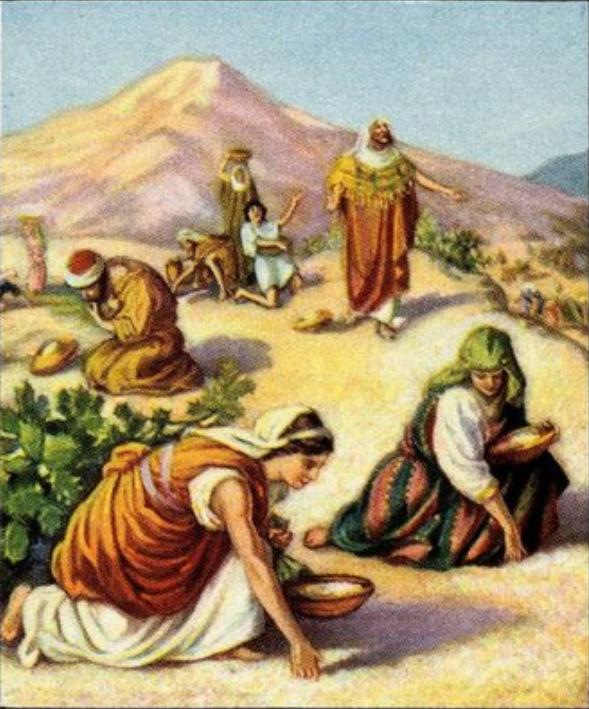
There is a misguided tradition, potentially developed by Reb Menachem Mendel of Rimanov, that one should recite Parshas Hamon (Exodus 16:4-36) on the Tuesday of this past week (B’shalach) in order to provide a “segula for parnassa” — loosely translated as a “charm for increased wealth.”
How is this to work? It’s certainly not working naturally (b’derech hatevah) — go get a better job for that. Is it supposed to work supernaturally (b’derech neis)? We’re not all praying for miracles, now are we. So this elusive segula concept is neither, which leaves it in the realm of superstition…and the prohibited, just like red strings and amulets.
Now I’m not saying that the recitation of Parshas Hamon is prohibited or even a bad idea — it’s a great one! The Shulchan Aruch (OC 1:5) explains that it’s a good idea to say it every day, explaining that one ought to ponder deeply on its message of recognizing God’s wonders as the source for all blessing in this world. We may take it for granted that meat, fish, eggs, grain and chocolate mints are nourishing, but if we stop and think daily about how God took a non-entity like manna and imbued it with enough sustaining power to nourish the Israelite nation for 40 years in the wilderness, we may come to realize that it is really only the dvar Hashem, the “word of God,” that imbues our food, and by extension, our medicine and our building supplied and our clothing with the natural ability to serve any purpose whatsoever. “B’dvar Hashem shamaim na’asu” — “by the word of God the heavens were created.” (Psalms 33:6)
Too many of us have been raised on the falsehoods of Judaism so that we grow up, wonder how we can have been so silly for so long, and we want to drop it all because all we know is silliness. It’s like this girl I know who’s been dating for so long, and she’s tried everything, and now she doesn’t even bother to date anymore — she just does the segulas, and so she’ll be dead before she get’s married.
And let’s save debate about the initial premise for next week — Yisro.
Beautifully written 🙂
why, thank you!
> the verse from Shoftim is a directive that our relationship with Hashem should be “perfect,” in the exclusive sense… this cannot be referring to other gods, because that would be outright avodah zarah, but that it rather refers to one who attempts to mitigate his destiny by consulting astrologers and observing superstition.
It cannot refer to avodah zara because avdoah zara is explicitly forbidden elsewhere, right?
> Too many of us have been raised on the falsehoods of Judaism so that we grow up, wonder how we can have been so silly for so long, and we want to drop it all because all we know is silliness.
Yeah, but when you start learning about the real stuff, it just gets worse. Segulos are silliness, and maaseh bereishis can be reconciled with an old Earth. But what about the mabul, three million people leaving no trace, the thematic similarities between sefer Bereishis and the Enumah Eilish, the evidence that the Israelites were at best monalatrous, and most not even that, that the Israelites were originally a sub-culture of Canaan…
It’s all about where you draw the line. Rationalists draw the line at blatant superstitions that aren’t attached to the core of rabbinical Judaism. Others draw it at believing that dinosaur skeletons were God’s idea of a practical joke, meant to fool us into believing that the world is much older than it really is. And still others draw it at ignoring the historical evidence.
1) Yes, my implicit reference to avodah zarah was because it is already forbidden by much more explicit prohibitions that temimus could not possibly be referring to it.
2) True — it will all depend upon what you need to establish. All I need to establish is Judaism’s truth, and I propose that it is true because God said so publicly. So without getting into how we can know God’s existence (this week), let’s take it for granted that an all-mighty God told us that it’s true. But what is it that he told us? So for thousands of people, segulas are true. My friend’s wife previously had a miscarriage and sometime around when she conceived the next time, he bought her a ring of rubies — but she was sort of going to get it by herself anyway. It’s not only that it’s silliness — it’s prohibited! But she’s not my wife, so I didn’t divorce her.
When you say the Israelites were a sub-culture of Canaan, doesn’t the Chumash support that idea as well? Israel was from Isaac was from Abraham, and the ideas we retcon that they originated come from a time when they lived among the Canaanites, so maybe I just don’t understand the problem you’re trying to bring out.
Only ignorant people think dinosaur bones in the ground are meant to fool us. God created the Torah and he created nature, and there’s no reason to suspect that nature is tricking us any more than the Torah is tricking us — in other words, it’s much more plausible that nature is to be taken literally.
> let’s take it for granted that an all-mighty God told us that it’s true.
I see. And you’re trying to show that part of what He told us is that segulos are assur. Sounds good. But I don’t think that those who use segulos see it as superstition. It’s seen as kabbalistically manipulating unseen spiritual forces. And kaballah was given to Moshe at Har Sinia along with Tanach, gemara, and all the seforim that anyone is ever going to write.
> When you say the Israelites were a sub-culture of Canaan, doesn’t the Chumash support that idea as well?
Interesting point.
What I mean is that archeology does not show any evidence of Canaan being conquered at the time Yehoshua is supposed to have conquered it. The style of pottery and dwellings don’t suddenly change. The current theory is that the Israelites started as a Canaanite subculture that gradually rose to prominence.
> Only ignorant people think dinosaur bones in the ground are meant to fool us.
I wish that were true. See the Omphalos hypothesis: http://en.wikipedia.org/wiki/Omphalos_hypothesis
I can’t be expected to vouch for ignorant people. So if they think kabbalah magic is Judaism, and my rebbeim tell me that it’s nonsense, I’m well within my scope of Orthodox observance to scoff at them using my rebbeim as study defense.
I’m unaware of all of these historical anomalies you bring as counterproofs to Torah stories — I’ll speak to my Jewish history PhD rabbi friend and get back to you on that.
I’ve seen the Omphalos argument fro Slifkin and thought it was a great concept the first time I read it — again, though, lots of ignorant people say ignorant things, and what am I to say if they are too ignorant to understand that they are ignorant? It’s a bizarre thought to say that God is tricking humans, because it opens the door to a five-minute year old universe subsumed within a Matrix-like brain in a vat thought prison trick. These ideas are espoused by people too unfamiliar with science to have issues with changing everything around.
Have you ever read Slikfin’s Challenge of Creation? You should — he build such a great argument until the end, when he provides a nearly implausible answer to all of his questions. But his questions are great.
G*3~
I spoke with my friend, R’ Evan Hoffman (assistant rabbi at Park East Synagogue in Manhattan) about your Canaanite culture question — his response was that your comments are entirely valid but concerns relating to your questions on historicity of the bible are less than unsettling because of 2 points:
1) Jewish monotheism was very not different than Canaanite idolatry in culture, and no great disparity should be expected. Other than religion, they were both living in the same place in the time period, and their art and manufacturing were likely identical — it’s not as though we claim that Jews came with disposable diapers, PETE water bottles and Keurig K-cups and you’re able to ask how come there’s no evidence of a culture shift in the form of evidence from archeological digs.
2) The Bible and the Prophets make clear mention in various places of how the turnover was slow — Joshua did not enter with armies, obliterate the standing governments and Canaanite communities and conduct a takeover that would leave evidence of a rapid shift. Rather, conquest was slow, arduous and piecemeal — from a historical perspective, R’ Hoffman suggested that there would be so much overlap that distinction would be all but impossible (and, as explained, expected as such).
Tamim tihyeh is referring to not subverting relating to God directly, ie through divination, as spelled out in the previous pesukim. We don’t need to because has a direct relationship with us. The next pesukim lay out the basis of belief in the Torah (Sinai), along with the reason God sends prophets and doesn’t relate to us directly today (We asked Him not to on Mt. Sinai because it’s too hard for us).
The 613 Mitzvos that God gave us, though, are all irrational at the deeper level. So I don’t really understand R’ Schachter’s complaint. Aren’t all Mitzvos essentially “occult” practices, just focused on one God instead of many? Even if you follow Ramchal that they’re used to focus our mind on God, with different categories of Mitzvos for different times etc. Isn’t it likely that a nation living in a superstitious environment would see these Mitzvos in that vein. (The Rambam is famous in giving this outlet reason as an explanation for Karbanos!) And that 3000 years later in Europe, segulos would be used that way too by the hamon am?
That’s a very good question, ODB. Let me look into that and get back to you.
Thanks. I’m looking forward to hearing the answer.
R’ Hoffman tells me that superstitions are inherently irrational — like not “stepping on a crack lest you break your mother’s back.” There’s no reason to think that sidewalk cracks have anything to do with your mother’s back, or that cracked mirrors have anything to do with foretold unfortune, or the like. So adhering to such practices fall well within the realm of superstition.
Despite what the superstition Wikipedia article has to say about it, practice of Jewish law is performed by Jews out of devotion to God and his mandate. We have been instructed by God to do X and Y and to not do Z and we comply with varying levels of loyalty depending on many factors. Fundamentally, we ignore consequences and follow the law blindly — merely because it is the law — despite how odd or silly such adherence might appear to an uninformed onlooker.
R’ Hoffman does offer one caveat, though — R’ Chaim of Volozhin would certainly state that mitzvos are indeed superstitious occult rituals, but I suppose I would be inclined to disagree, and maybe you would too.
I’m still waiting to hear back from R’ Feldman.
I just ran across a Rashba (quoted by shomer emunim who quotes Ein Yaakov) who argues with the “following blindly” approach to focus our minds on God (Letzareif daas yisroel). He’s arguing with the philosophical Rishonim.
His basic point is that doing mitzvos is for our own good (spiritual food and medicine). See here, second column:
hebrewbooks.org/pdfpager.aspx?sits=1&req=19567&st=%u05e1%u05d5%u05db%u05d4
Derech Hashem actually creates a synthesis of the two approaches in Chapter 4 (points 5 &6). I quoted the main thrust above, but he works the other approach in as well.
My point with all this is that this is a machlokes even among the Rishonim. You can say that the Jews were probably told at the time what the point was behind doing the Mitzvos. But it’s safe to say that by the middle ages the hamon am had no idea what was flying.
Plus, you still haven’t answered how the Rambam could hold of Karbanos being Avodah Zarah nicotine patches. This isn’t just a side question. If the polytheistic, quid-pro-quo-relationship religion is being rejected in favor of a deeper, altruistic, One God religion, appeasement sacrifices should be rejected out of hand.
The Rashbas on page 225, 2nd column.
I must say that you speak with such encompassing metaphors, it’s sometimes difficult for me to catch your intent on the first read.
Anyway, Judaism is very complex and the easiest way to understand things is often the simplest — God revealed himself, and so we are essentially choiceless in our decisions to meet his rules of life. These rules are intricately woven into a tapestry of dos and don’ts that complement and build upon one another, so that we can, for example, have discussions about chatzi shiur relating to chametz as well as melachos shabbos.
Of fundamental importance is being keenly aware of the distinction between something deemed necessary by God and something deemed of prime importance by the rabbis, and I don’t just mean doraisa and drabbanan — I speak of concepts, such as our understanding of which mitzvos mean this and which mean that and why this and why that — the fact that so many interpretations and explanations exist is evident of both many layers of actual explanation (i.e. that things were explained to Moses that way) as well as interpretation (i.e. that the Rabbis provided meaningful insights into things, without them necessarily having been there initially).
The hamon am hasn’t changed from whence it began; it never did really understand and it still doesn’t — I think that’s why it’s called the “hamon am.”
Moreover, I don’t think it’s necessary to blindly follow the Maimonidean approach — not saying that I don’t agree with him on lots of things, but I haven’t nearly read even the minority of his works, instead relying on rebbeim to, over time, construct a sort of Maimonidean documentary in my mind, and lots of what he has to say sounds quite palatable, and so I fuse it with my perspectives and call that reality. But I don’t think anyone has a thoroughly comprehensive worldview that is acceptable by anyone, because everyone will have his personal biases.
I hear that. I’d like to know an explanation for the Rambam’s view though, if you can ask one of your Rebbeim. I don’t mean to give you homework, it’s just that I don’t feel comfortable dismissing the Rambam’s shita without understanding him first.